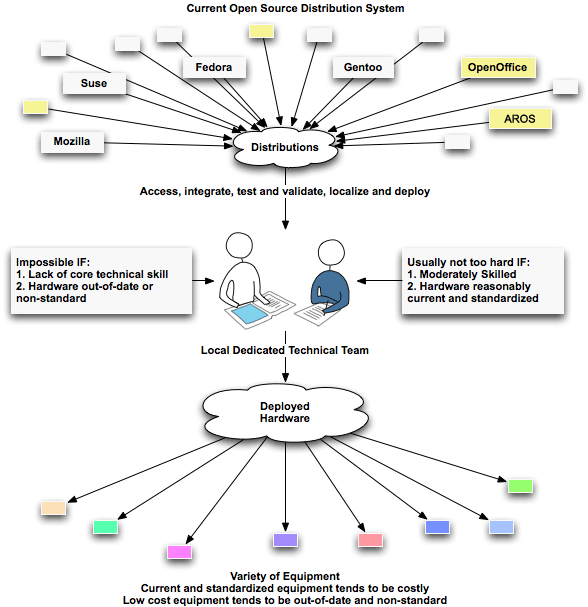
The challenge to delivering information and communications services: There are two ways to deploy systems today. Neither works for emerging communities.
Method One: Commercial Systems and Applications with Current and Standard HardwareThe first is to use commercial systems. The advantage is that a proprietary operating system with an integrated set of localized applications can be delivered and maintained. The disadvantage is that this is costly to initiate and that high costs continue after delivery with mandatory annual fees for upgrades and maintenance. Commercial systems also require current and standardized hardware that is more costly to acquire and maintain. Competent local technical support needs to be available to support the systems on-site. The fees are often unaffordable in a community with a per capital income of less than $1/day which is often the case in rural and remote communities which tend to use very little cash. If fees are not paid and maintenance kept current, the environment becomes very difficult to maintain, if not impossible, as it outdates or it operates outside of any existing licensing agreement. This can place the community between fees that cannot be maintained and software piracy that increases the vulnerability of the environment. Past experiences with continuing fee and support costs and the risks associate with piracy have built substantial barriers to continuing to attempt to deploy commercial solutions in emerging communities. Method Two: Locally managed open source with non-standard hardwareOpen Source solutions appear to offer a much lower cost alternative to commercial solutions. However, significant barriers have blocked success. The first challenge is that a skilled team has to select a distribution of Open Source, such as Red Hat Fedora or Novell Suse, and then build a distribution image from the thousands of applications within the distribution. This image then has to be deployed locally to the desired end-user system.
If the end-user system is low cost, it is also likely out-of-date or non-standard. Thus, it is likely to have conflicts with the deployed image. These conflicts could include video drivers, printer and other peripheral drivers, networking compatibility and disk reliability. The local team has to resolve all of these conflicts and incompatibilities for the system to be successful.
The second challenge is that there must be skilled local technical support that can maintain Linux based open source systems and applications. The cost of the required technical resources precludes deployment except in concentrated areas such as universities and medical centers. The frustrating result is that neither commercial solutions nor open source solutions meet the requirements of emerging communities. The first is too costly and the second is too complex.
|